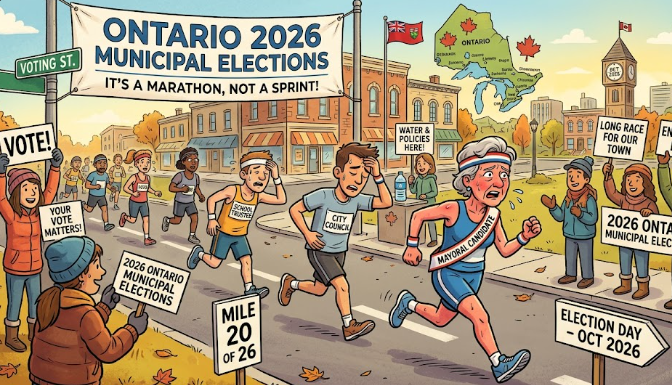
If you’ve stepped outside recently or glanced at local social media pages, you might have noticed a familiar buzz starting to build. Signs aren’t officially lining the streets of Chatham-Kent just yet, by law, those don’t pop up on public property until August 27th, but the race for the 2026 municipal election is officially on.
Nominations opened on May 1st, and across our eight diverse wards, a large number of candidates have already filed their paperwork at the Civic Centre to run for Mayor, Council, and School Board Trustee.
But with Election Day not taking place until Monday, October 26, 2026, many residents are asking the exact same question: Why on earth is this campaign period so incredibly long? Let’s pull back the curtain on why Ontario municipal races feel like a marathon, how candidates can survive the pacing, and what voters actually think about it.
Why Is the Campaign Period So Long?
Much different than federal or provincial elections, which usually wrap up in a snappy 36 to 50 days, an Ontario municipal campaign spans nearly six months from the opening of nominations to the final ballot count.
There are two primary reasons for this extended timeline:
- Fundraising and Accountability Laws: Under the Municipal Elections Act, a candidate cannot spend a single penny or accept a single dollar in donations until their nomination papers are officially filed with the clerk. Because municipal candidates don’t have massive provincial or federal party war chests to rely on, they use their own funds and need months to systematically raise funds from supporters, order materials, and build a campaign from scratch.
- The Massive Geographic Challenge: Take a look at Chatham-Kent. We aren’t just a single compact city; we are a massive, single-tier municipality encompassing urban hubs like Chatham and Wallaceburg alongside vast, sprawling rural areas like South West Kent and North East Kent. For a candidate trying to, get their name across thousands of square kilometers of farmland and small communities, a few weeks simply wouldn’t cut it. They need months just to logistically reach their constituents.
The Candidate’s Dilemma: How to Pace the Marathon
Sprinting out of the gate in May, a candidate will be utterly burnt out by August, bankrupt by September, and a ghost by October. For the folks throwing their hats in the ring, survival is all about strategic pacing.
Experienced local campaigners generally divide this massive window into distinct phases:
Phase 1: The Invisible Groundwork (May – June)
This isn’t the time for loud rallies. Early summer is for planning your campaign, building community support and volunteers, mapping out your ward’s key rural and urban splits, and setting up your bank account. Focus heavily on private fundraising and listening tours.
Phase 2: Targeted Engagement (July – August)
Use the warm weather to your advantage. Attend community festivals, small-town farmers’ markets, and local events across the wards. Start high-level door-knocking, but treat it as an introduction rather than a hard pitch. Listen to what residents are worried about, whether it’s consistant tax increases, infrastructure upkeep, or community revitalization.
Phase 3: The Blitz (September – October)
Once Labour Day passes and the kids are back in school, the real race begins. This is when voters finally start paying attention. Deploy your signs, ramp up your digital ads, attend the local debates, and hit the doorsteps hard. Save at least 40% of your total budget and energy for the final four weeks.
What the Voter Thinks: Democracy vs. Fatigue
For everyday citizens in Chatham-Kent, a six-month campaign is a double-edged sword.
On one hand, the extended timeline gives voters a genuine opportunity to see who these candidates are under pressure. In local government, where party lines don’t exist, we vote for the person, not the political brand. A long campaign exposes who is truly dedicated to showing up at local events, who understands the balance between our agricultural sectors and urban needs, and who has a realistic plan for our municipal budget.
On the other hand? Voter fatigue is incredibly real. By the time October’s early voting rolls around, many residents are completely exhausted by the constant stream of social media arguments, door-knockers, and flyer-filled mailboxes. When an election feels endless, people have a tendency to tune out entirely, which can contribute to the historically low voter turnouts that plague municipal politics.
The Takeaway
Ultimately, the long Ontario municipal campaign is designed to level the playing field, ensuring that grassroots, first-time candidates have enough time to match the name recognition of long-standing incumbents.
As we watch the candidate lists update daily at ckelection.ca, the challenge for our local hopefuls is clear: engage the community without exhausting them. And for us voters? Let’s try to stay patient. The decisions made on October 26th will shape the next four years of Chatham-Kent’s roads, parks, taxes, and community growth—and that’s worth a few months of our attention.
Follow my campaign as I run to represent Ward 1 in Chatham-Kent.
My campaign facebook page
My campaign website
Support my campaign with a donation




Leave a Reply