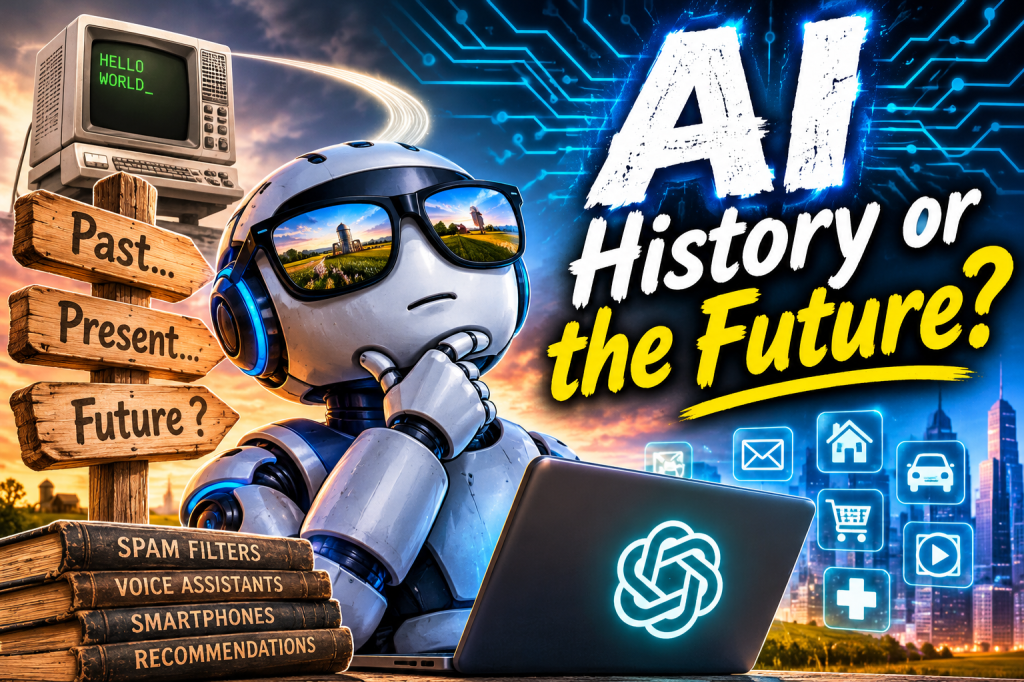
From spam filters to talking robots, AI has been around longer than you might think. So why is everyone talking about it now?
Let’s talk about AI.
No, not the kind of AI where a robot walks through your front door, takes over your house, raids your fridge and starts telling you how to live your life. Although, depending on who’s programming it, I suppose that’s not entirely out of the question!
I’m talking about Artificial Intelligence. Three little letters that seem to be popping up everywhere these days.
Scroll through Facebook, and you’ll find AI-generated pictures of people doing things they never did, standing beside people they’ve never met, or looking considerably better than they probably do first thing in the morning. You’ll see videos that look real but aren’t, music created by computers, articles written with the help of AI, and people arguing in the comments about whether any of it should even be allowed.
Some people think AI is the greatest thing since sliced bread. Others think it’s going to put us all out of work, destroy creativity, and eventually take over the world.
And then there’s the rest of us, sitting somewhere in the middle, wondering what all the fuss is about.
But here’s the interesting part. AI isn’t nearly as new as some people think. We’ve been using it for years. We just didn’t always call it AI.
So, is AI old news, or are we standing at the beginning of something that will change just about everything?
Let’s have a look.
First things first. What exactly is AI?
Artificial Intelligence is technology that allows computers and machines to perform tasks that normally require some form of human intelligence. That can include recognizing patterns, understanding language, making predictions, solving problems, and generating text, pictures, music and videos.
It doesn’t mean a computer has suddenly developed feelings, common sense, or a burning desire to spend Saturday afternoon at the golf course.
At least, not that we know of.
AI systems work in different ways. Some analyze information and make predictions. Others recognize speech or images. Newer generative AI tools can create entirely new content based on instructions we give them.
And that last part is where things have really taken off.
Tools like ChatGPT and other AI assistants have made it possible for ordinary people to sit down at a computer or pick up a phone and have a conversation with technology that can help write a letter, explain a complicated subject, brainstorm ideas, create an image, or help plan a vacation.
You don’t need to be a computer programmer. You don’t need a degree in computer science. You don’t even need to know exactly what you’re doing when you start.
You just ask a question.
Which is great, because most of us have been asking questions our entire lives. We just used to have to wait for someone to answer them.
Hang on a minute. Haven’t we had AI for years?
Absolutely!
The term artificial intelligence dates back to the 1950s. Researchers have spent decades developing systems that can carry out tasks associated with human intelligence. What has changed is the technology’s capabilities, accessibility, and the attention it’s receiving.
Think about some of the things you’ve probably used without giving AI a second thought.
Your email. Ever wonder how your inbox knows that message about winning a million dollars from a prince you’ve never heard of belongs in the junk folder? Spam filters have been using intelligent systems for years to help identify unwanted messages.
Your smartphone. Autocorrect, predictive text, voice assistants, and features that recognize faces or improve photographs can all use AI. That phone in your pocket is doing considerably more than making calls and letting you scroll through Facebook while waiting for your coffee.
Your GPS and navigation apps. When your navigation app estimates arrival times, analyzes traffic, or suggests an alternate route, AI and other predictive technologies can help make those decisions.
Of course, it doesn’t always get it right. We’ve all had that moment when the GPS sends us down a road that makes us question whether the person giving directions has ever actually been there.
Shopping online. Ever bought something online and noticed the website suggesting five other things you apparently need? Recommendation systems analyze patterns in what people browse, buy, and watch to suggest things they might like.
Apparently, looking at one fishing lure is enough to convince the internet that you’re about to open a professional tackle shop.
Netflix, YouTube and social media. These platforms use recommendation systems to decide which videos, shows, and posts you’re likely to find interesting. The more you watch and interact, the more the system can tailor its suggestions.
And that’s where things get particularly interesting, because these systems don’t just help us find things. They can also influence what we see, what we believe is popular, and how much time we spend online.
So, while AI might seem like the new kid on the block, it has been quietly working behind the scenes for quite some time.
The big difference today is that AI isn’t just analyzing information or making recommendations. It’s increasingly capable of creating things for us.
And that’s a whole different ball game.
AI on social media. Is that real, or are we being fooled?
This is probably one of the biggest reasons AI has become such a hot topic.
Social media is filling up with AI-generated pictures, videos, voices and stories. Some are funny, some are creative, and some are so realistic that you have to look twice.
You might see a picture of an incredible wildlife encounter, a celebrity doing something outrageous, or a video of a politician making a statement that sounds completely unbelievable.
Before you hit Share, it might be worth asking yourself one simple question:
Did that actually happen?
AI can create images of events that never took place, generate convincing voices that sound like real people, and produce videos that make someone appear to say or do something they never did.
Some of this is harmless entertainment. People are having fun, experimenting with technology, and seeing what they can create.
But there is a serious side to it.
Fake news, scams, impersonation, misleading political content, and manipulated videos can all become more convincing when AI is involved. A picture that looks authentic isn’t necessarily proof of anything anymore. Neither is a video.
And let’s be honest. We already have enough trouble agreeing on what’s true without adding computers that can manufacture convincing evidence to the mix!
The problem isn’t simply that AI can create something fake. People have been making things up since long before computers existed.
The problem is how easily convincing material can now be produced, how quickly it can spread, and how difficult it can be to tell what’s genuine.
My advice? Slow down before sharing something shocking. Look for the original source. Check whether reputable sources are reporting the same thing. And if something seems too outrageous to be true, take a minute to investigate.
That goes for political posts, celebrity gossip, miracle cures, and those unbelievable stories your cousin’s neighbour’s friend keeps sending around.
AI makes it easier to create convincing content. It doesn’t make that content true.
And just because something has a hundred thousand likes doesn’t mean a hundred thousand people have checked whether it’s real.
The good side of AI. There’s plenty of it.
With all the talk about misinformation, lost jobs, and computers taking over the world, it’s easy to forget that AI can also be incredibly useful.
In fact, some of its most valuable applications aren’t nearly as exciting as a robot doing backflips on the internet.
They’re the everyday things that save us time, help us solve problems, and make certain tasks a little easier.
At home and in everyday life
Need help planning a week’s worth of meals using what’s already in your fridge? AI can help.
Trying to understand a complicated letter, compare travel options, organize a household budget, or come up with ideas for a birthday party? AI can help with that, too.
Want to learn how to repair something, understand a new hobby, or get a simple explanation of a topic you’ve never understood?
You can ask.
It’s like having a research assistant available whenever you need one. Just remember that it can make mistakes, so important information still needs to be checked.
At work
This is where AI could make a real difference for a lot of people.
Imagine having help drafting emails, summarizing lengthy reports, organizing meeting notes, analyzing spreadsheets, creating training materials, or brainstorming ways to improve a process.
For someone managing a production floor, planning schedules, tracking performance, or trying to find ways to make an operation run more efficiently, AI can be another tool in the toolbox.
It can help identify patterns in data, assist with forecasting, support quality-control processes, and help people work through problems more quickly.
It doesn’t mean you hand over the keys and let the computer run the business.
People still need experience, judgment, accountability, and an understanding of what actually happens on the ground.
A computer might be able to analyze a production schedule, but it doesn’t necessarily know that the delivery truck is late, a machine is down, or half the crew has called in sick.
Well, unless someone tells it!
Used properly, AI can help people spend less time on repetitive tasks and more time on the work that actually needs their attention.
And then there’s the fun stuff!
This is where things get really interesting.
AI can help people create images, write stories, generate music, edit videos, develop game ideas, and experiment with all sorts of creative projects.
You don’t necessarily need expensive software or years of technical experience to get started.
Want to see what your dog might look like as a superhero? Go for it.
Want to create a picture of a futuristic Wheatley, a fishing adventure with a giant muskie, or a robot trying to play a round of golf? You can give it a try.
Want help putting together a karaoke playlist, writing some lyrics for an original song, or coming up with a funny social media post?
There are AI tools that can help with those things, too.
And yes, you can even use AI to help write a blog post about AI.
I’ll leave you to decide whether that’s clever, ironic, or just a little bit of both!
The point is that AI gives people new ways to experiment, learn, and create. It can help turn an idea into something tangible, even if the person having the idea doesn’t have all the technical skills to do it themselves.
That’s a pretty exciting development.
So, what’s the problem? Why are people so divided?
For all its potential, AI raises some legitimate questions.
What happens when jobs change or certain tasks become automated? How do we protect personal information? Who owns an AI-generated image or song? What happens when a business relies on AI and it makes a mistake? How do we know whether the information we’re reading is accurate?
These aren’t silly questions, and they shouldn’t be brushed aside simply because the technology is new and exciting.
There are also concerns about creativity and authenticity. If someone uses AI to generate a picture, write an article, or compose music, how much of that work is their own?
I think the answer depends on how the technology is used.
If someone uses AI to help organize their thoughts, improve a rough draft, or bring their own idea to life, that’s one thing. If someone passes off completely fabricated information as fact, steals someone else’s work, or deliberately misleads people, that’s another.
The tool itself doesn’t tell the whole story. The person using it matters, too.
And there is a difference between using AI as an assistant and expecting it to do all your thinking for you.
We should be teaching people how to use these tools responsibly, not pretending they don’t exist or assuming that everything they produce is automatically good or bad.
Like most technologies, AI comes with benefits, risks, and a learning curve.
Remember when the internet first started becoming part of everyday life? Or when everyone started carrying a smartphone? There were plenty of questions then, too.
Now, most of us wouldn’t think twice about using online maps, banking apps, or video calls.
AI is likely to become just as familiar in many areas of life. The challenge is making sure we understand what we’re using and where we need to be careful.
Is AI going to take our jobs?
This is probably one of the biggest concerns people have, and I don’t think anyone should dismiss it.
AI can already perform certain tasks that people are paid to do. As the technology improves, some jobs will change, some tasks will become automated, and some roles may disappear or be replaced by different kinds of work.
At the same time, new opportunities will emerge, and many jobs will continue to depend on human skills that technology cannot simply replace.
Think about judgment, leadership, empathy, creativity, practical experience, and the ability to deal with an unexpected problem when the plan falls apart.
Anyone who has worked in manufacturing, construction, agriculture, or just about any hands-on industry knows that having information available isn’t the same as knowing what to do with it.
AI might suggest a solution. A knowledgeable person still needs to decide whether that solution makes sense.
That doesn’t mean every job is safe or that the transition will be easy for everyone. It means we need to be realistic about both the opportunities and the challenges.
Businesses need to think carefully about how they introduce AI. Workers need opportunities to learn new skills. And governments, educators, and employers need to pay attention to how these changes affect people.
We shouldn’t fear every new development, but we shouldn’t blindly assume that progress automatically benefits everyone equally, either.
The future of AI. Where do we go from here?
Here’s where I think things get really interesting.
We’re moving beyond AI that simply answers questions or generates a picture. Increasingly, AI systems can help carry out more complicated tasks, work with different kinds of information, and assist with multi-step processes.
Imagine an assistant that helps organize a trip, compares options, builds an itinerary, and adjusts the plan when something changes.
Or a business tool that helps identify production bottlenecks, flags potential equipment problems, and recommends ways to improve efficiency.
In education, AI could help explain difficult subjects in different ways to suit individual learners. In healthcare, it can assist professionals with analyzing information and identifying patterns. In creative work, it can help people explore ideas that might otherwise have remained just that: ideas.
None of this means AI will get everything right. It won’t. And the more responsibility we give these systems, the more important it becomes to check their work and understand their limitations.
There will be mistakes, debates, regulations, and probably a few spectacular failures along the way.
That’s part of what happens when technology moves quickly.
The real question isn’t whether AI will continue to evolve. It almost certainly will.
The question is how we choose to use it, what safeguards we put in place, and whether we can take advantage of its benefits without losing sight of the people affected by it.
Because technology should be working for us, not the other way around.
One last thought before I let the computer have a break.
AI is not some brand-new invention that appeared out of nowhere yesterday. We’ve been using forms of it for years, often without realizing it.
What’s changed is that the technology has become more powerful, more accessible, and much more visible in our everyday lives.
I’m not convinced we need to panic about every new AI development, and I’m certainly not convinced we should accept everything it produces without question.
There’s a middle ground.
Be curious. Try it out. See where it can help. Use it to learn something new, solve a problem, or create something you wouldn’t otherwise have been able to create.
But keep your common sense switched on.
Check the facts. Protect your personal information. Think before sharing something online. And remember that just because a computer can produce an answer doesn’t mean it’s the right answer.
Maybe AI will change the world in ways we can’t fully imagine yet. Maybe some of the predictions will prove to be overblown. Probably a little of both.
Either way, it’s here, it’s evolving, and it’s worth understanding.
And if you’re still wondering whether AI is the history or the future, perhaps the answer is that it’s a little bit of both.
We’ve been using it for years. We’re using it now. And we’re only beginning to see what comes next.
Just don’t ask it to write your next golf scorecard. Some things are better left to human imagination!
Just saying…




Leave a Reply