Well, that’s another CFL season in the books, and congratulations to the Edmonton Elks on taking home the Grey Cup!
As for the Ottawa Redblacks, I’m sure they’re happy the season will be remembered for more than just their record. Sometimes, you just have to take the wins wherever you can find them. And if there aren’t many on the scoreboard, at least there’s always the off-season!
But while the players are putting their equipment away and fans are debating what went right, what went wrong, and whether their team’s quarterback should be traded, the CFL has something else in store for us.
In 2027, the league is literally moving the goalposts.
And they’re shortening the field while they’re at it.
No, this isn’t a late-night dream after too many Grey Cup snacks. It’s actually happening.
So, let’s talk about what’s changing, why it’s happening, and why some people are already wondering if we’re fixing something that wasn’t broken in the first place.
First, let’s talk about the changes
The CFL has announced some pretty significant changes for the 2027 season. The goal, according to the league, is to create more touchdowns, encourage more aggressive play, improve the flow of the game, and give fans a better viewing experience.
Here’s what’s coming.
1. The field is getting shorter.
The playing field between the goal lines will shrink from 110 yards to 100 yards. The end zones will also go from 20 yards deep to 15 yards.
Before anyone starts suggesting we just turn the whole thing into an NFL field, relax! The CFL field will still be 65 yards wide, compared with the NFL’s 53⅓ yards.
That extra width is a big part of what makes Canadian football different. It gives receivers room to work, creates more open space, and makes for some pretty exciting plays.
2. The goalposts are moving. Literally.
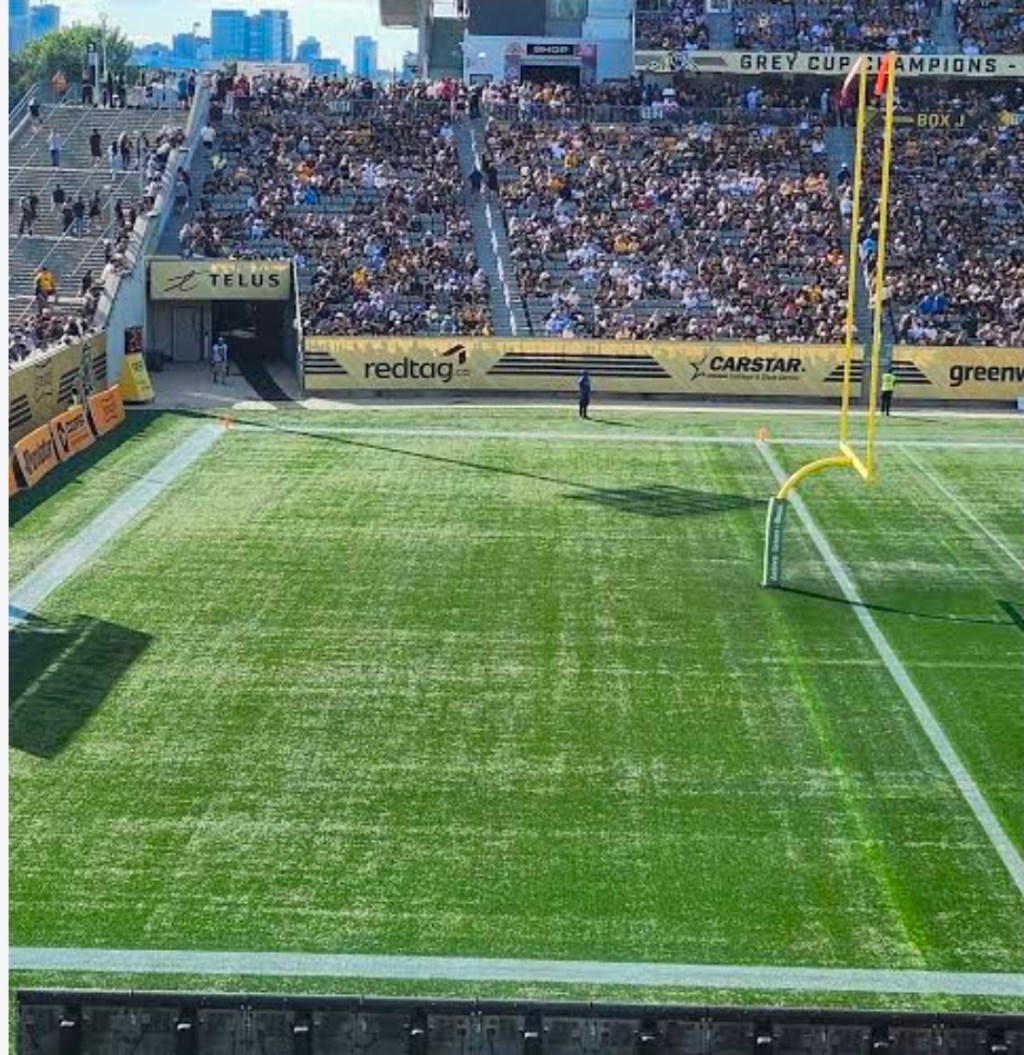
Right now, the goalposts sit on the goal line, right at the front of the end zone. In 2027, they’ll be moved to the back of the end zone.
Why?
The league believes moving them will open up the middle of the end zone for passing plays, reduce interference with players, and give fans a better view of the action.
The CFL estimates this could lead to 10% more completions in the end zone and about 60 additional touchdowns per season.
Sixty more touchdowns? That’s a lot of opportunities to jump off the couch, spill your drink, and scare the dog.
Of course, those are the league’s projections. We’ll have to see what actually happens when the players hit the field.
3. The single point — the rouge — has changed too.
This one started in 2026.
For those unfamiliar with Canadian football, the rouge is that single point awarded in certain kicking situations when the receiving team fails to get the ball out of its own end zone.
Under the revised rules, a missed field goal that goes wide won’t automatically earn a point. Neither will a punt or kickoff that sails or bounces through the end zone untouched.
The single point remains in certain situations when the returner fails to get the ball out or takes a knee in the end zone.
The idea is to make teams work harder for their points and encourage coaches to take more chances instead of settling for a kick and hoping for the best.
4. The game clock and team benches have changed.
Also introduced in 2026, teams will have their benches on opposite sides of the field, and a 35-second play clock will automatically begin when the previous play is whistled dead.
That should reduce some of the delays between plays and make the game flow more consistently.
Apparently, even football needs a little help keeping everyone moving!
For the league’s explanation of all the changes, you can check out the official CFL rule changes FAQ.
Wait a minute. Isn’t Canadian football supposed to be different?
Now, here’s where I might ruffle a few feathers.
I know some fans aren’t happy about these changes. They worry the CFL is slowly turning into a smaller version of the NFL.
I get it. Tradition matters. And when you’ve watched a game a certain way for decades, the idea of changing the field, moving the goalposts, and adjusting the rules can feel like someone has walked into your garage and rearranged all your tools.
You know where everything belongs. You don’t need someone coming along to tell you the hammer would work better on the other side of the shelf!
But let’s be honest. The CFL has changed before, and it will change again.
The question isn’t whether the game should ever evolve. The question is whether these changes make the game better without taking away what makes it Canadian.
And for me, that’s the important part.
A word for our American friends
For anyone reading this from south of the border, let me explain something.
We Canadians don’t need the NFL to tell us how to play football. We have our own version, and I happen to think it’s a pretty darn good one.
For starters, we have three downs instead of four. That means teams have less time to get those 10 yards, which encourages passing, creative play-calling, and some pretty gutsy decisions.
We have 12 players on the field instead of 11, giving the game a different balance of offence, defence, and open space.
Our field is wider, our end zones are deeper, and we allow motion toward the line of scrimmage before the snap. That last feature, often called the waggle, gives Canadian offences a chance to build momentum before the play even begins.
And then there’s the rouge. Only in Canadian football can a kick result in a single point under the right circumstances. It’s one of those rules that can leave an American watching the game wondering what on earth just happened.
We have a different game, a different strategy, and a different kind of excitement.
Personally, I love the fact that our game isn’t simply a copy of somebody else’s.
And if you’re an American who has never watched a full CFL game, give it a try. You might discover that the extra space, fewer downs, and different rules make for some entertaining football.
You might even become a fan.
Just don’t expect me to agree that four downs are better than three. We all have our limits!
My own football story
I’ll admit something. Before my boys started playing football, I wasn’t exactly what you’d call a die-hard fan.
I’d watch a game now and then, but I wasn’t planning my weekend around it.
Then my kids started playing.
Suddenly, football became a whole different experience. You start paying attention to the rules, the plays, the coaching decisions, and all those little things you probably wouldn’t have noticed before.
You learn what the players are doing, why they’re doing it, and how much work goes into every single game.
And the game my boys played was Canadian football.
That’s the game I grew to appreciate. It’s the game that got me interested, and it’s the game that made me understand why so many families spend their weekends at football fields across this country.
There’s something special about watching young players learn the game, work as a team, and develop a little confidence along the way.
So when I hear people ask whether these changes will make the CFL less Canadian, I understand the concern. I don’t want us to lose the things that make our game unique either.
But I also think we need to give the changes a fair chance before we decide the sky is falling.
After all, the goalposts are moving. That doesn’t necessarily mean the game is moving in the wrong direction.
Although I suppose if your favourite team keeps missing field goals, moving the posts might not be the worst idea!
And now, Saskatchewan has entered the conversation
Just when you thought moving the goalposts was enough to keep everyone busy, along comes another debate.
This time, it’s about the field itself.
The Saskatchewan Roughriders play at Mosaic Stadium in Regina, and the city has chosen to have the field markings stitched into the artificial turf rather than simply painted on.
Why does that matter?
Because not everyone who uses the stadium will be playing under the CFL’s new 2027 rules.
The university and junior football programs are keeping the existing Canadian amateur field dimensions for now. That means their field markings won’t line up with the new CFL dimensions.
If the lines are painted on, they can be changed or covered as needed. If they’re permanently stitched into the turf, it’s a much bigger problem.
The CFL commissioner, Stewart Johnston, has publicly urged Regina to use painted lines instead. His argument is that painting makes the stadium more adaptable for the different football organizations using it.
The city, however, has some pretty reasonable concerns of its own.
Mosaic Stadium isn’t just home to the Roughriders. It hosts university and junior football, community sports, and other events. The city says repeatedly painting and removing lines would mean closing the field while the paint dries, reducing access for community users, increasing operating costs, and potentially losing revenue.
In other words, the city doesn’t want to trade away valuable field time just so someone can grab a paintbrush.
And honestly, I can see both sides.
The CFL wants to modernize its game and needs fields that meet its new requirements. Regina wants to make sure a stadium used by many different groups remains practical and accessible.
Surely, there’s room for a sensible solution here.
Perhaps that means a workable painting system, a clear agreement about costs, or another approach that lets everyone use the stadium without one group carrying the entire burden.
But here’s the thing: if the CFL wants these changes, the league and its teams need to work with the people who operate the facilities. They need to understand the costs, the scheduling headaches, and the impact on the other organizations that call those stadiums home.
You can’t just announce that the goalposts are moving and expect everyone else to figure out the mess afterward.
Well, apparently, you can. But that doesn’t mean it’s the best way to do business!
So, will these changes actually make the CFL better?
That’s the million-dollar question.
The league believes a shorter field and goalposts at the back of the end zones will create more scoring opportunities and encourage teams to be more aggressive.
Maybe they’re right.
Maybe we’ll see more touchdowns, more exciting finishes, and coaches taking chances they might previously have avoided.
Or maybe some of the changes will take a little getting used to, and we’ll find ourselves debating them over coffee, at the local watering hole, or around the television on game day.
That’s part of being a sports fan, isn’t it?
We all have opinions. We all think we could call a better game than the coach. And we all know exactly what the quarterback should have done after watching the replay 14 times.
But I do hope the CFL remembers that its biggest strength is its identity.
Three downs. Twelve players. A wider field. The waggle. The traditions, the rivalries, and the fans who have supported this league through thick and thin.
That’s what makes Canadian football Canadian.
Moving the goalposts might help the game grow, but the league needs to make sure it doesn’t move the goalposts so far that it loses sight of what made the game special in the first place.
I’ll be watching in 2027, that’s for sure. I’m curious to see how it all plays out.
And if the changes lead to more touchdowns and a few more exciting finishes, I suspect even some of the doubters might come around.
I don’t normally cheer for the Redblacks, and with the season they just had, you can understand why. But there is a player on that team that I watched when he was playing youth football, and I want to support him. I have been an Edmonton and Toronto fan for years now, but maybe I could become an Ottawa fan? Some things are harder to change than a football field!
Just saying…




Leave a Reply